Showing posts with label ce. Show all posts

Tuesday, March 18

Purim

Happy Purim!  We've never celebrated Purim before, so this year was a bit of an experiment.  I won't pretend to know much about Purim.  I did some research and, as we just spent a couple months studying Esther in adult education at church, the story was fresh in my mind.  

We shared a meal of Persian stew with friends (this recipe: good, though I think the 6-8 is servings is very optimistic.  If you are serving it as a main, I'd say it serves 4.)  We also had ham and cheese hamantashen for the kids (using puff pastry) and traditional hamantashen for dessert.  For me, the highlight of the evening was Jim reading this picture book of Esther with the children all booing and playing shakers at the name of Haman and cheering at the name of Mordicai.

I'd love to go all out, dress up and do a play some year; but for a first attempt, our little Purim was a fun celebration.  We all enjoyed a wonderful Biblical story, and in my mind that is a success!
Hamantashen translates as Haman's pockets, but these cookies are also held to look like his three cornered hat.  In Israel they call them 'Oznei Haman' meaning Haman's ears.


The kids loved the hamantashen and Jonah took some to his class at school today too.

Thursday, February 27

Flannel-graph Fun

You can see Isaac's toes peeking out from under the blanket on the right.  He fell fast asleep while watching the stories.
I heard once that we should look to what we loved to play in childhood to find our passions.  I don't tend to take this sort of thing too seriously, but looking back, I do laugh to think that two things I spent countless hours doing were first, taking care of my babies.  And second, using my mom's Sunday school supplies (flannel graph, signs for songs, and teaching manuals) to teach my stuffed animals.  Mom encouraged this play by buying me an attendance chart and stickers so I could make sure that all my animals showed up for their lessons.  She also bought me a couple sets of my own flannel graph (Esther and Moses).  When I started teaching sunday school lessons at age twelve to the twos and threes at church, it didn't even occur to me that I was young, I had been doing this regularly for years (all be it with stuffed animals).

Another find from the bins from my childhood were the three felt bible scenes (palace, outside and small home) and all the flannel graph I used as a child.  Oh my, we had so much fun on a snowday using the Moses set together and Rowan spent a long time with the David set (mostly playing with the arrows.)  I'm looking forward to getting more out and I have a couple boys who really want me to buy some white flannel to draw some more scenes (the Moses story calls for a dessert and mountain scene, which we don't have.)

I have the flannel-graph downstairs, but in a place where the boys can get it out (though one story at a time is the rule) and bring it up to play with it.  It is such a joy to see them playing with the biblical story.  Seeing them play with the stories (even when they are playing with arrows and changing things around,) I am reminded so beautifully that it isn't just any story, it is their story and my story, a story in which we are called to play a part.

Sunday, January 26

The Feast Day of Saul's Conversion

The above Bible is The Gospel Story Bible.  Rowan received this story Bible for Christmas and overall I really like the parts we've read so far.  It isn't the best storytelling, but is accurate to scripture and the illustrations are interesting (all in the simple style above.)

I'm determined to celebrate more of the 'lesser feast days' this year.  I'm still figuring out what that should look like and would LOVE feedback from any of you who have traditions on any of these days.  In the past we've done a saint day some months and I put some thought into the meal and have a dessert.  But, if we are going to have feast days more often, I don't have the budget, time or the desire to add that many sweets.  There have to be other fun ways to celebrate these days.  I definitely want to base our 'feast' around the story, but am hoping to be slightly more creative as we go.

Last Saturday was the feast day of St. Peter's Confession, so we simply read that scripture after dinner and talked about it again before bed.

Today, the feast of Saul's Conversion.  After dinner I read the biblical account (Acts 9) and then read the story out of two different children's Bibles.  We've done this a couple times before, but I have been meaning to do it more often as Mr. 7 is very ready for this kind of exercise.   After the biblical account we read it out of The Bible for Children (lower left in photo below).  This children's Bible (with a few exceptions) sticks to the words of scripture pretty accurately and this story was well told.  Then we read the The Jesus Storybook Bible (upper left in photo below) which is always more imaginative in its telling of stories.  I don't mind a more imaginative telling, but do want the boys to learn to discern when something is imagined or a possible interpretation.  Both Rowan (4) and Jonah (7) had a lot of fun pointing out what Jones added to her telling of the story and I really wanted to talk to the boys about the 'sunday school myth' of Saul changing his name upon conversion.  It is possible that he changed his name to reflect his conversion, but I think it more likely that he simply started going by a greek version of Saul as he reached out to the gentiles.   Again, I don't have any problem entertaining the idea that maybe he changed his name to reflect his conversion, but I do think that it is best to be aware of when authors like Jones like to add lots of stuff to the story.  


*Note on photo above - The Children of God Storybook Bible is in the upper right hand corner of this photo.  We didn't read it tonight, but I read it when deciding what to read.  We have this Bible out of the library this week and I've enjoyed what we've read so far (Genesis and the prophets.)  The illustrations are done by lots of illustrators from around the world and are hit or miss (some I really like and others are pretty poor quality and/or cartoony, which I'm not crazy about.)  Jonah actually noted the different illustrations and had some great commentary on the various styles; that was a very fun discussion.
We ended up doing some pastel and watercolor after dinner with the younger boys at Isaac's request- the lower right is the quick piece I did while we painted (the boys painted monsters, knights and dragons.)

Tuesday, February 5

Paint Your Blessings

Last week we read the lesson about Jesus blessing the children in our Bible curriculum.  I like that the lesson focused on what a blessing is and what it means to open oneself to receive a blessing.

It seemed appropriate to bless the boys after the lesson and I decided to do a secret message blessing (a big hit with mystery loving boys.)  I wrote a blessing in white crayon ("May Christ's light Shine in You, Jonah!" and "May you, Rowan, know God's love for you!") on white paper and then let them watercolor over it and discover the message.  When they were finished I blessed each boy with the words they found.

We also enjoy singing Let the Little Children Come by Steve Green when working with this story. 

 Isaac was just given a paintbrush and water with construction paper.  It was his first encounter with painting, so that was fun to watch!  He loves, loves, loves drawing with crayons (and markers if he can find them... and somehow he does manage to find one most days!)


Thursday, January 31

A Playful Story: Water Into Wine

I mentioned before that we are working our way through the first book of Telling God's Story
by Peter Enns.  It has been slow going as I keep pausing to follow the church year.  But, all the same we are making our way though and in December we read the story of Jesus turning water into wine.  One thing that I like about this curriculum is that it lets the words of scripture tell the story, just adding an intro and then some thoughts after.  Don't get me wrong, I love the careful storytelling of Godly Play and certain children's Bibles, I just love having both!

The way I presented the story brought up an interesting developmental question in our home.  I read the scriptures aloud with the boys about water turning into wine.  As I read, I poured water from a clear glass into a tall mug (that had an inch of grape juice at the bottom that they could not see.)  And then I poured the new mixture back into the clear glass.  Now, I want to point out that the intent was never to trick the boys or to make them think that I was turning water into wine, but simply to have something visual to encounter as we read the story.  It was beautiful watching the clear stream of water fall and then watching the ruby-colored 'wine' return to the glass.

After we finished reading the scripture and lesson, I did the illustration again and showed them how I did it (just to be clear that I was not turning water into wine).  Jonah (6.5) really enjoyed it, understood that I was just creating a picture to help illustrate the story, and found it interesting.  But Rowan (3) just asked me the other day (a month later) if I remembered when I made water into wine.  I asked him if he remembered the story and he did remember quite a bit.  I reminded him how I made the water look like wine and how Jesus really turned water into wine.  This has really made me think.  I could have told you that developmentally Rowan isn't ready for this sort of symbolic gesture and really had it more in my mind for Jonah (it is part of his curriculum after all).  It made me wonder if I wished I hadn't done it with Rowan present.  In the end, I don't regret doing it as I'm sure it will all be clear for Rowan eventually.  But, it has certainly made me ask if I would do it again and if so, in what setting.  In a classroom I would certainly hold off on this illustration until children were old enough to understand it as a symbol.  But, in a multi-age setting, I think there is a place to work with the older children's symbolic understanding (always being clear that it is just a symbol) and know that the younger children will sort it out later.  At least, thats what I think right now...

I'd love to know if anyone else has thoughts on this.  I certainly think this isn't a single answer sort of question.


-----------------------
We have a table here with a single drawer that I have godly play figures in and I've been attempting to have a story set up for the boys to play with occasionally... though the pieces are often removed rather quickly for other play.  

Wow, these pictures really show how smudged well-loved our little peg people are these days.  For this story I bought six dowel caps and painted them grey to be the six stone wine jars.  Small blocks made tables with some little wooden bowls for the wedding feast.


Wednesday, April 4

Lent and the Good Shepherd: Good Shepherd Magnets

I love working with magnet paper.  You can use it in a printer, but it is also fun to draw on.  I took a sheet with me to York and drew up a set to use for the lost sheep story.  It was inspired by Butterworth and Inkpen's story The Lost Sheep, though I added in dark shadowy places (like the godly play story).  The boys loved listening to the story and Rowan especially loved telling it again and again hiding the lamb somewhere new each time.

I've drawn sets similar to this (but different stories) and copied it off on the magnet paper for kids to color and take home after church in the past, but haven't since leading godly play.  I do love that kids can retell the story to parents and play with it on their own at home through the week.  What do you think, is there room for a work a less open-ended option like this in a godly play setting?

Sunday, March 11

Lent and the Good Shepherd: Psalm 23


 I've been fascinated by mothers of great men in the past couple years.  I went to a lecture about Tolkien last year and was struck by how instrumental his mother was in shaping who he became.  And, at the book shower my family threw for Isaac last summer, my aunt gave me the book Moms Who Changed the World.  It has been sitting on my bed-stand for sometime, neglected, not for lack of interest... but because there are so many books that catch my interest.  Anyway, I've just begun it and have enjoyed the first half.  The thing that struck me the most in the first few chapters was the amount of memory work these moms (Susanna Wesley, Margaret Ruskin...) did with their children.  And they weren't memorizing a verse here or there out of context, they were memorizing passages.  Memory verses are great, but I am often annoyed at how some of the most popular 'memory verses' are memorized without thought to the greater story they are placed in, leaving them bereft of the meaning they are meant to convey.

I've been amazed at the speed my boys (and small children in general) memorize.  So as we play with the story of the good shepherd this Lent we are memorizing the 23rd Psalm.  I wrote it out and illustrated it and made copies for school and dinner time readings.  It is fun to hear Rowan recite the first lines and comforting to know that he is internalizing that 'The Lord is [his] Shepherd."  And in this time of change and unknowing I'm really needing these words too.


Wednesday, November 2

All Saints Day

All Saints Day is something I've wanted to celebrate with the boys for the last few years, but it just hasn't happened.  At the Godly Play training I was able to look through book 7, which is the stories of the saints.  And I have a dream of making up story bags for several different saints (like the one I made for St. Patrick) to share through the year and to delve into on All Saints Day.  I love the idea of sharing stories of those who have gone before us through history and celebrating their love for God, others and creation.

Yesterday I woke up thinking that I would love to make doughnuts to celebrate and that I wanted to tell a story with figures.  Well, neither of those things happened, but we did go to the bakery to buy doughnuts and took them to Daddy as a surprise at work.  And we made a saints game, which was a lot of fun (more fun to make than to play I think!)

We were at church in the morning for a play group and looked at a stained glass window of St. Leonard, which we see every week and always makes me wonder who he was and what he did.  We came home and read his story in a book of Saints we have out of the library.  Later in the Day Jonah helped me make a paper chain (St. Leonard's symbol because he is the patron saint of prisoners) and then the boys and I made or found symbols of a couple other saints we knew (heart - St. Valentine, clover - St. Patrick, dragon - St. George...) and then we read some stories and looked up the symbols (this website is very helpful) for saints we didn't know much (if anything) about (St. Ambrose - beehive, St. Gregory - dove, St. Brigid - cow...)  We collected all the symbols in a bowl and had a bit of a quiz for Daddy and a friend after dinner to see how many they knew.

So, for a first attempt it was a lovely All Saints Day (they are still talking about the doughnuts!)  Do share in the comments if you have (or have heard of) any fun All Saints Day traditions!

Sunday, October 30

Onward through Genesis: The Tower of Babel

The boys loved cutting bricks and building a city and tower of Babel.  The game on the table is called 'Turmbau zu Babel' (Tower of Babel).  I found it in a charity shop and we can't read the instructions because they are in German, but we enjoy  building the tower.

Tuesday, October 18

Favorite Noah Books

There are so many books about the story of Noah.  And for awhile, I was collecting Noah books in particular, so I have over a dozen, but only a few joined us in Scotland - our very favorites.   So here are the ones we read over and over.  

:: Noah's Ark by Jerry Pinkney:  This book is beautifully illustrated.  I love Pinkney's style and the text does the story justice.  I love the way he fills the page with animals giving a sense of chaos and giving a sense of what having all those huge animals piling onto a boat might have felt like.

:: Noah's Ark by Lucy Cousins - Lucy Cousins' bright, childlike illustrations are so popular among children (as seen with the Maisy series) and her Noah's Ark is equally appealing.  Simple and bright it is the best Noah's ark I've found for a very young child.  Pictured below is the board book, but I highly recommend buying another version, because the board book is abridged and some of the most literarily fun pages are omitted.  


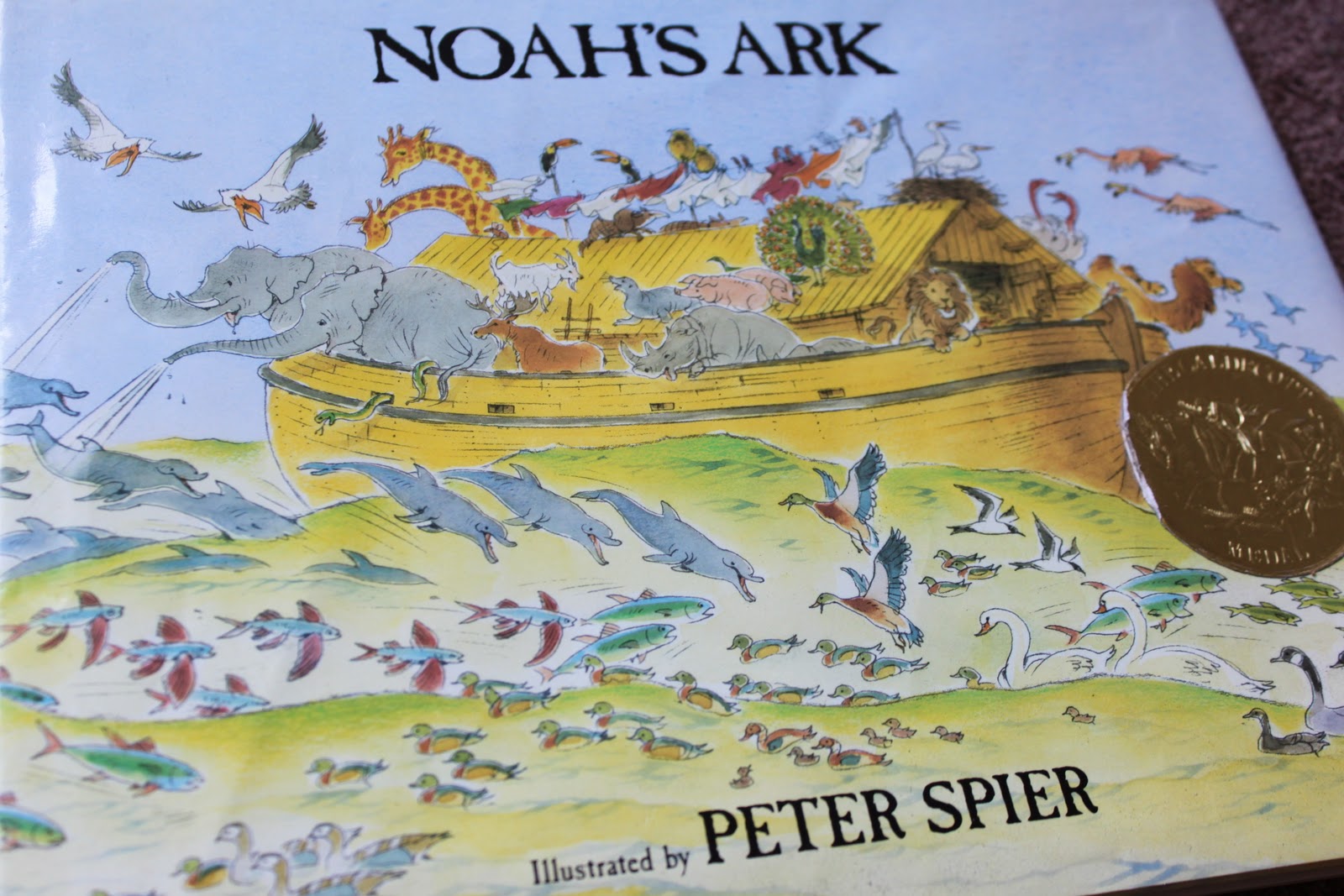
:: Noah's Ark by Peter Spier - This is my very favorite!  I love Spier's illustrations!  The book begins with a poem, but is otherwise wordless.  He asks so many questions with him images and really engages the reader's imagination.  We have spent so much time pouring over this book, looking at the owls eyes staring out from blackness, wondering what all the animals would eat, and generally marveling at the story.  I also love that Noah is shown tending the 'garden' at both the beginning and the end, showing God's original intent for mankind to be keepers of creation.  


:: On Noah's Ark by Jan Brett - This is certainly NOT the first book I would recommend buying on Noah, primarily because she gets the story all wrong.  I don't mind that Noah's granddaughter is telling the story, after all, it is quite possible that there were grandchildren who just aren't mentioned, but I do think the fact she forgets to mention God changes the story considerably!   So why do I mention this book?  Because, I have found it a wonderful teaching tool.  After telling children a good acount of the story where God is seen as the rescuer and promise maker it is a lot of fun to read this beautifully illustrated (I love Jan Brett's work) version ending with the question, so what did the author leave out?  The few times I've done this someone first points out that she only has one bird go out, then the fact the granddaughter is telling the story is discussed, and then, someone realizes that God isn't in the story.  It is a wonderful discussion to have with older children asking "How does that change the story?, Is God an important part of the story?, What is the big idea in the Biblical account and how is this story different?"

Do you have a favorite Noah book?  What do you like about it?  Please share in the comments.

Friday, October 7

A Rainbow Sort of Day...


 We've been reading through Genesis as a family (starting with creation, which I shared here) and we just finished up Noah's story.  So we've been thinking about God's promises and, of course, rainbows.  The above verse has been the verse we've been sharing and memorizing (and we'll continue with it through Abraham, because this theme of promises just keeps going through Genesis).  I cut the watercolor above into a puzzle for Jonah (but it was frustrating as the watercolor paper didn't want to stay together well - next time perhaps I should back it on poster board before cutting the puzzle)

The boys attend a 0-5s group at our church every Tuesday morning and they spent the past few weeks studying Noah.  We were able to time it so that finishing our reading of Noah and the 'Rainbow Party' at their church group coincided.  Jonah made a card for the leader with wet on wet watercolors and we attempted to make Rainbow cookies.  I just used our normal sugar cookie dough and food coloring to make the colors (I used liquid dyes as I didn't have paste dye available - I'll bet the paste would work better).  I was pretty disappointed with the colors and then they totally faded when we baked the cookies.  But the boys were thrilled with them and very excited to share them at the rainbow party, so they were a success even though mama wasn't thrilled with the finished product.

Monday, September 26

Our Favorite Creation Books


This is my favorite creation book.  When I first read it to our little class at church they all oohed and awed as I turned the vibrant pages; the illustrations are amazing (and great templates for doing art work with kids).  But, I think my favorite part of this book is that the text is a poem.  The original text of Genesis one is a poem and this book does a beautiful job of putting words together playfully.


This is the Beautiful World that God made.  
This is the light, brilliant and bright,
        that formed the first day from a dark, endless night
        and started the beautiful world that God made.
This is the heaven, so skillfully framed, 
        a glorious firmament God breathed and named, 
        that glowed in the light, brilliant and bright.  
This is the land and God-gathered seas, 
       the grass, ferns and flowers, the fruit-bearing trees,
       that sat beneath heaven, so skillfully framed...


It continues in this manner through the seventh day of rest and then turns and comes back again ending with ... and started the beautiful world that God made.


The boys love Wonderful Earth by Nick Butterworth and Mick Inkpen.  It has lift the flaps, half pages to turn and make silly creatures, pop-ups and the text is really fun.  The first part of the book delights in the amazing things that God has made and the book ends with a heavy environmental message.  I typically don't like books that are too finger-pointing/moralistic in their message for young children, but this one is such fun at the beginning and I care so deeply about the message they are trying to promote that it remains one of our favorite creations books.

I love this book.  The illustrations are simple and lovely.  The book is aimed more at an older child and requires a comfortability with metaphor.  God is seen as a young artist in the book creating the world.  The end of his work (and the book) is creating human kind.  (And I've been known to tear up at the end.)
...he worked all night long.  And by morning he had made a new artist in his own image.  Shyly pleased with himself, he made another one.  He loved the company.  He made one more.
The world began filling up with artists.  These made new ones and the new ones made even newer ones and, of course, they all loved to daydream.  Living among blue water and green grass, they have daydreamed the most beautiful things in the world.
The first young artist, still a dreamer, has always called them his children.
And they in turn, have always called him God.


Adam and Eve and the Garden of Eden moves into Genesis two and three, but it also does a good job (through illustrations) of delighting in creation.  I always love Jane Ray's illustrations and the only thing I'm not crazy about in this book is the giant eyes that represent God's presence with them in the garden. I'm not sure how I would do it differently, but something about the eyes staring down seems impersonal to me and lacks the image of God walking with them in the garden. 

Do you have a favorite book about creation?  Do share in the comments - we always love new books to look for!

Wednesday, March 23

Right now I'm...

:: Hoping the baby sleeps through the night after a rough afternoon of being sick.   

:: Recognizing the fruit of the Spirit for Jonah when he shows them and then, letting him add a grape to this magnetic puzzle on the fridge (made from a sheet of magnet printer paper, a sharpie, and beeswax crayons).  I'm cautious of overly 'rewarding' good behavior (though potty training definitely defied this general rule!), but it has been really helpful to name the fruits of the Spirit through our day and Jonah is loving it.  And, this exercise has made me ask some good questions like "when do we show faithfulness in our days?" and "is Mum showing Joy in the midst of sick-days?" 

 :: Remembering Rowan's "TRACK - TOR!" this morning when he spotted a green machine at the botanic gardens.  He chased the tractor around the pond, where it stopped and he was offered a chance to sit in the tractor... "Track-tor, Track-tor, TRACK-TOR" was his cry!

:: Making Jonah lenten mazes.  A simple way to mark this time.

:: Enjoying spring, fresh foods and everything green.  It is light till seven now, which feels like such an accomplishment and the sun is shining some days.  I even picked up a pack of seeds at the store today (we are moving in June, so we aren't planting much of a garden this summer, but the spring weather demands a few seeds!)

:: Rejoicing that not only did I hang clothes up to dry outside today, but for the first time this year they were fully dry before dinner!

Thursday, March 10

Prayer with Children

A question I've been asking a lot over the past few years is 'how do you help your child pray?'  I think the question looms large for me, because I don't understand prayer myself.  Oh, there are quite a few books about prayer lining my shelves, so I can tell you lots about prayer, but on a more practical level I feel like I struggle along.  My personality isn't contemplative by nature and the demands of small children make quiet space infrequent.  One of the most pivotal moments in my spiritual life was when I realized that having a relationship with God is not reliant on 'quiet times'.  Don't read this wrong, time alone in the Bible and in prayer is a great thing, but there is nothing biblical about needing 'daily quiet time'.  Certainly we are to seek and know God's word and are to desire to be in prayer continuously, but I believe that this will look different in different season of our lives.   For me, at this time, reading the word and prayer are much more organic in my days: Jim and I discuss a passage one of us is studying in a group over dinner, I find myself praying over soapy dishes, find that a conversation with a friend has turned into a sort of prayer, study scripture to lead my Bible study or to answer a specific question, practice a godly play lesson, do godly play with the boys...   I suppose that if I had to sum up the most common prayer in my life I would say that it is simply 'being aware that God is with me and welcoming that'.

I know that there is lots of room for growth in this area for me and while I mention that God is with us through our days (to which Jonah now says quite seriously 'oh, I know, I know') I want to share prayer on a more tangible level with the boys.  Some children are eager to say prayers each night, but Jonah has always asked that we 'do the talking'.  He takes part in our mealtime graces and I know that God is working in him, but I want to create spaces and opportunities for him to pray when he is led.  I never want prayer to be an expectation or something he feels coerced to engage in.  The other factor in praying with Jonah (or any child) is that, on many levels, I'm pretty certain that he could teach me many things about prayer and so I want to enter the conversation with God and Jonah not primarily as guide, but as fellow children of God.

 I made the goal to do one new simple prayer with the boys each week in Lent and I will try to share them here because I would love to begin a conversation and hear what others are doing.  I would love suggestions or resources if anyone knows of anything!
Our first week was inspired by my Bible study's work in Galatians.  I simply took nine rocks (from the myriads of stacks of rocks in this house) and wrote the fruit of the spirit on them with sharpies.  

The boys and I lit a candle and then I prayed "God give us..." and then handed Jonah each rock, which he read and then dropped into a bowl of water.  

I left the bowl out and several times in the past day I've heard 'ping, ping, ping'.  Jonah my 'just be playing' with the rocks in water, but the space is there and he is engaging and as far as I'm concerned that is prayer.  He is aware that this is a space we created to talk to God and he is going there and doing what he does to form relationships and ask questions - play.  

Do you have any prayers or prayer activities you have done as a family you can share in the comments?  

Thursday, February 17

The Story of Joseph

There are certain stories, like Joseph and Noah, that have myriads of picture books devoted to them.   When I was working as a children's pastor a favorite part of my job was reading children's bible story books.  I made lists of good ones for parents, bought the best for the church collection and to be used in class rooms, and discarded those I felt certain didn't do the story justice.  There is such a range when it comes to Bible story books.  Some are terrible with artless cartoony illustrations and/or bad exegesis, but there are some gems out there too - artfully done, thoughtfully written and inspiring one's imagination to enter a story at a new level.  

So here are my two favorite on the story of Joseph.  (Joseph has come up in our history curriculum - so Jonah has been sleeping and playing in his 'Joseph coat' for the past couple days.  And we've been reading these books.)

The Coat of Many Colors by Jenny Koralek and illustrated by Pauline Baynes

The text of this book does the biblical account justice (though it condenses bits of the story and leaves something important out - we'll get to that).  The text also enters the story imaginatively, which is lovely, though it adds a fair amount (i.e. Joseph promises to never boast again if he gets out of the pit, there is detailed description of the coat...), but I'm quite comfortable with the imaginings.  I really enjoy the authors voice and overall the story is quite good.  There is only one major flaw with this retelling and that is that God isn't mentioned.  And really, it isn't  a problem until you reach the end and Joseph says "Of course I forgive you,... We have all learned many lessons since I first put on the coat of many colors.  And now, go and bring our dear father to me.  Then we can all share my good fortune in this land of plenty."  There is nothing wrong with what is said, but it feels like a joke without a punch line to me.  The point of the Joseph story is that even what Joseph's brothers meant for evil God meant for good; God, was caring for his people and providing for them.   She tells the story beautifully, but misses the 'big idea' of the biblical account.

But, despite one count against it, it is still a favorite because of the illustrations (and I think that a child who is getting good biblical teaching in other ways will be enriched by the book and with an older child it is good to see if they can find what is missing in a text like this.)  Pauline Baynes is best known as the original illustrator of Narnia (and I highly recommend finding a copy of Narnia with her brilliant illustrations!).  I love her illustrations.  They invite you into a story, but are simple, leaving lots of room for your imagination.  She has a fabulous sense of line and I love the repetition and simple shapes in her illustrations.  But the best way to share why I love them is to let you take a peak...
And my other favorite is Joseph by Brian Wildsmith.  I ask for this book when I was in high school.  I came across it in a catholic book store and my mom bought it and stashed it away for a Christmas gift. The detail in the illustration and the small bits of gold caught my eye and my imagination.  It is a book that you can spend hours with as the illustrations are highly detailed.  The story is very true to the biblical account, though it is condensed for young readers.  It is aimed at a bit older child than The Coat of Many Colors, but even at 16 months, Rowan has enjoyed looking at the illustrations.  We particularly enjoyed Joseph in conjunction with our history curriculum as Jonah could find so many Egyptian items that we have learned about in the past couple weeks.

Sunday, January 23

Godly Play 3: Creating a Space

If you are new to this space you might appreciate reading Godly Play 1: What is Godly Play and Godly Play 2: Materials before you read this post.
-----------------------------------------------------------------------------------------------------------------------------------
While many churches that use godly play have beautiful rooms filled with shelves of wooden figures, golden parable boxes and natural art materials, that just isn't practical for most of us in our homes.   I think that a small table or end stand can suffice.  We use a small end stand that is part of the furnishings of our rented home and house it in the corner of our dining room.  I would love someday to have a small alter for seasonal cloth and candle, small shallow shelves beside it to house our materials and a small desert table with a lid (so it can be used with or without sand).  But for now our simple table works quite well.

the story on the table is "The Man Who Said Thank You" found in Luke 17: 11-17
I've mentioned before that when I talk about godly play at home I'm not talking about using the godly play scripts that you find in the curriculums.  We do use those some; but what I'm talking about here is creating a place that children can play with the biblical story and christian practices.  Perhaps I should come up with another name for this, but for now, just know, that when I say 'godly play at home' it looks different than 'godly play' proper.  In some ways it reminds me more of the waldorf style story tables and less of montessori trays and lessons.  When I tell stories at the table (or often on the floor beside the table or at our meal table) I typically read the scripture before hand and then tell the story in my own words.  I particularly love telling stories from the Pentateuch (The first five books of the Old Testament) this way, as some believe they were told for hundreds of years before they were written down during the exile.  I love to think that I am passing these stories in my voice to my children, just as the people of God passed them to their children so long ago.

The Space:

We have a cloth the color of the church season over the table (above it is green for ordinary time) and perhaps some postcards or prints depicting some stories we are working with or coordinate with the church season hanging above.

Our table has one shelf that holds our materials: two baskets of figures, a small box with felt pieces, strips of fabric for roads, rocks and other small items, a box of blocks (we use haba's middle eastern blocks), a couple electric candles, and a stack of cloths (both for the church year colors and to create the landscapes for different stories).  There are so many more things I would love to make and add, but really a few figures and some cloths are all you need to start.

:Under the table we have some books -children's Bibles, Bible story books, The Common Book of Prayer, an illustrated Nicene creed, the Lords Prayer, and several other books.  I would love to share some of our favorites in this space and will work on that, but for now, it is enough to say that a good collection of books is a wonderful addition.  I sometimes find Jonah with figures and a book acting out what he is reading.

:Beside our godly play table is our nature table, which is actually a hunt-board filled with paper and other art supplies, so if there is ever a desire to do an artistic response everything is available to little hands.

If you decide to create a space for godly play at home, I'd love to hear what you come up with.

Wednesday, December 22

Jesse Tree: Part 2

Here are the rest of our Jesse tree ornaments for the year and a picture of the tree with three weeks worth on it.  The tree looks nice and I'm pleased with how this project turned out.  You can see Jesse Tree: Part 1 here (where I explain the concept).  Again, I used these devotionals and symbols as general guidelines.  We began on the first of December instead of the first day of advent (simply because I didn't get myself organized in time) so we didn't use a couple of the days listed and I rolled the days on Zachariah and Elizabeth Story and John the Baptist into one (somewhat long) devotional and used the baptismal shell to represent both these stories.   

Overall I've been very happy with the devotional and Jonah has enjoyed this each night after dinner.   In the future I would love to work on the prayers and questions to draw out more discussion, but for our young family the simplicity has been fine.

Note: I changed two of the symbols completely.  I used the hand of the prophets instead of the flower the devotional provides to represent the prophets.  The flower had nothing to do with the passage read or the devotional, plus Jonah is familiar with the godly play symbol of the finger pointing to Bethlehem.  I knew this was a good choice when he excitedly exclaimed "Look, it is the hand of the prophets pointing us to Bethlehem" when he drew this leaf out of the calendar.  I also chose to use the godly play symbol of the Road to Bethlehem instead of the sandals to represent their journey.  I like the winding of a path to symbolize a journey and, again, Jonah is already familiar with the symbol.

Top Row: Samuel's horn of oil that anointed David, King David's Crown, The hand of the prophets, Elijah's sacrifice at Mt. carmel
Bottom Row: Jonah's whale, The king's staff from Esther's story, Bethlehem, Daniel and the Lions
Top Row: John the Baptist (a shell has been traditionally used in baptisms),  Mary's Love, Joseph's tools
Bottom Row: the road to Bethlehem, The star of the Christ Child